

After the bombs drop
On the grief of war, Iranian diaspora life, and the rituals that save us

This week I’m sharing a personal reflection on what it means to be of Iranian heritage in a time of war. If this kind of writing resonates, you can support my work by subscribing or upgrading to become a paid member.
I’m grieving a lot at the moment.
I’m grieving the soil that nourishes Iranian families with its yields. I’m grieving the sea that replenishes and sustains those living close to its shores. I’m grieving the air, which was already so hard to breathe in Tehran. I’m grieving all those who lost their lives in the protests in Iran in January. I’m grieving the loss of outrage when a million people are forcibly displaced from their homes in Lebanon. I’m grieving the idea of taking my daughter to meet her family any time soon. I’m grieving the friends who haven’t checked in to ask how I am, and who somehow expect me to chat about the most banal things while I am literally watching bombs fall on my motherland.
I’m grieving the Iranians who, through desperation, trauma and privilege, have lost their empathy for the suffering of others. I’m grieving the damage to Iran’s UNESCO heritage sites. I’m grieving the future prosperity of a country whose vital infrastructure has been deliberately targeted. I’m grieving the brave Red Crescent workers across the Middle East who risk their lives to save others, knowing full well that Israeli and US bombs often fall with a “double-tap” strategy — striking once, and then again minutes later, when aid workers have rushed in to help.
It’s a lot of grief to carry. And that isn’t even half of it. I just don’t have the energy to finish the list. That’s the thing with grief. It makes you so tired.
The irony isn’t lost on me that I spent the last four months telling you how much I was enjoying my break from social media, how I’d tackled my phone addiction and was learning healthier ways to consume the news. It’s fair to say that’s all gone out the window.
When the protests — and subsequent massacres — took place in Iran in January, despite my obvious worry, I was able to manage my anxiety from spiralling. Perhaps it was because I believed the uprising might signal change. But also, I’m sure, because I wasn’t consuming violent footage on a small screen in my hand 24 hours a day.
Now I find myself reaching for that addictive rectangular piece of aluminium throughout the day and night. When I wake up, I try to delay checking the news, desperately stretching out the moment before I find out whether bombs have fallen somewhere I know. Whether it might mean a family member or friend has been killed.
At night, just before bed, I check once more. Just in case. Because I would want to know.
But we can’t know. Information is scarce. Internet and telecommunications to the outside world have been cut off for people inside Iran since the war began.

I’m known for my anti-war activism. I spent many years working on Iraq, Afghanistan and Palestine at a global justice charity, where I saw first-hand the devastation that bombs cause and the corporate complicity behind so many of these crimes — impacts that are felt for decades. I remain convinced that war is an abomination, no matter the circumstances. No one wins. People only suffer. Violence only breeds more violence.
But a war driven by Netanyahu (a wanted war criminal) and Trump (where to even begin?) has a particular insanity to it. Its effects ripple across countries, across lives, with consequences we are only just beginning to grasp. I read today about millions across India who have run out of fuel to cook because of the conflict, and I felt that grief again.
Since the war began, I’ve broken my self-imposed social media ban to stay informed, and I’ve been sharing updates when I can, but not as loudly as some might expect.
Partly, that’s a response to the way certain elements of the Iranian diaspora — led by Clown Prince Reza Pahlavi — have, in recent years, created a cult-like environment, directing extraordinary levels of verbal abuse at anyone who disagrees with them. It’s been shocking, bizarre and downright violent. And the older I get, the less interest I have in being pulled into that kind of chaos.
It is also, in part, exhaustion. After the last few years of watching a genocide unfold in Gaza and being unable to stop it, something in me has worn down. When bullies are allowed to act with impunity, what did we expect would follow? My words fail me in describing the cruelty.
There is also something harder to explain. Self-censorship runs deep through the Iranian diaspora, as it does in Russian, Cuban or Chinese communities. When you know governments may be monitoring what is said — especially if you travel back, or hold a British passport — you have to decide what you are willing to risk. If most of your family still lives there, you also have to consider who else you might be putting at risk.
I carry this heaviness with me. To be expected to speak, but only in ways that satisfy others. To be judged for silence yet not have any more words left to say about this awful mess. To carry fear of online mobs, political factions, or of whether you might see your family again if you say the wrong thing.
That heaviness is compounded by my background. Of being told that you are not Iranian enough to speak. That being half Iranian somehow disqualifies you from having a voice — even when that country lives in your bones, in your family, in your rituals, in your language, in your memories and in your dreams.
To know, too, that parts of the diaspora carry their own prejudices. That being half Pakistani can invite a different kind of dismissal, shaped by the racism and Islamophobia that exist within our own communities, particularly in the Iranian diaspora in the USA.
You see, being quiet is not indifference. It is, sometimes, the cost of surviving.

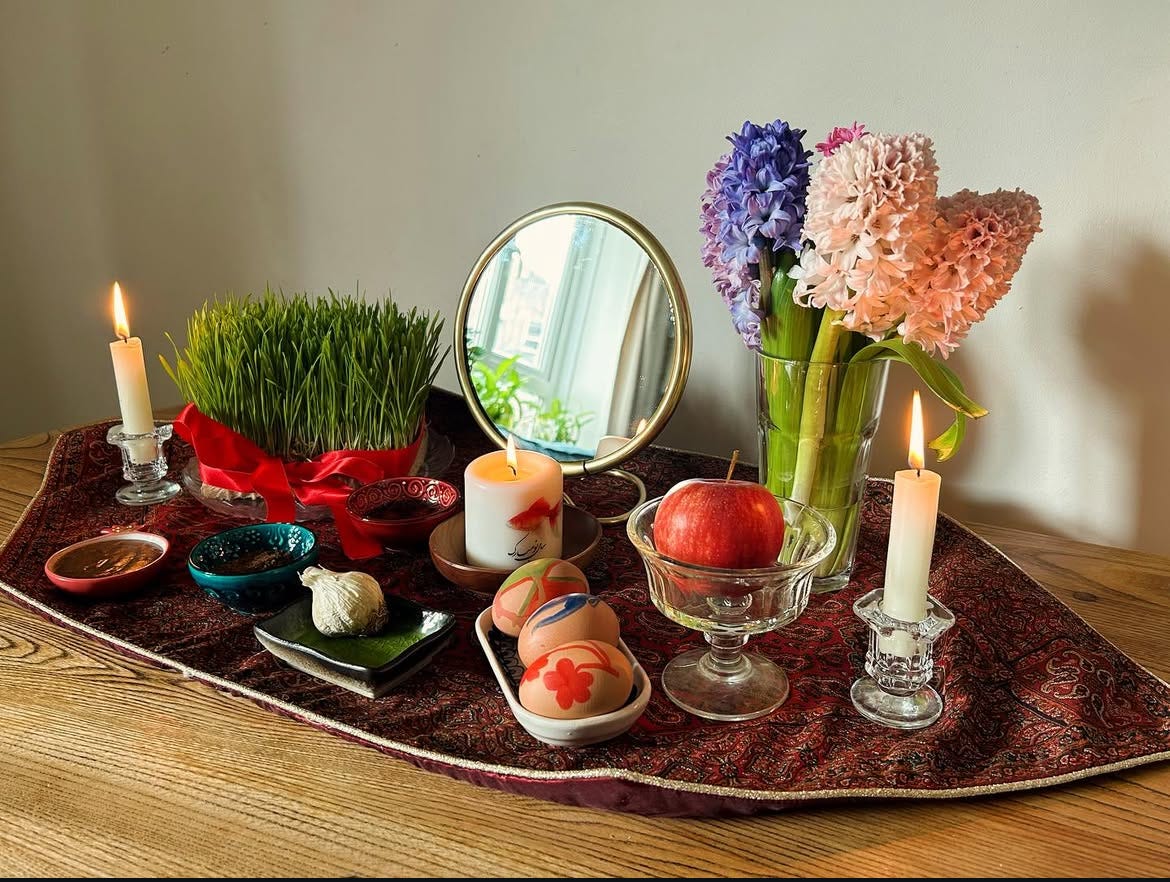
As I type these words, the sun is streaming into my office. The sky is bright and blue. It’s Nowruz tomorrow — the Persian New Year — which marks the first day of spring and the beginning of the year in the Iranian calendar. Nowruz means “new day” in Persian, and it falls on the spring equinox, a moment of renewal and rebirth. It has always made sense to me that the year begins here, when blossom emerges from the trees and the natural world begins its cycle of growth again.
Normally, the days before Nowruz are full of activity: shopping, cleaning, preparing the haft-sin table with its seven symbolic items, each representing what we hope to carry into the year ahead. But my heart has felt heavy this week. In all this grief, it has felt hard to celebrate. But a conversation with a Ukrainian friend changed my perspective. She reminded me that wars are not only physical, they are psychological, and that part of surviving them is maintaining our spirits, with culture being one of the most powerful ways to do that.
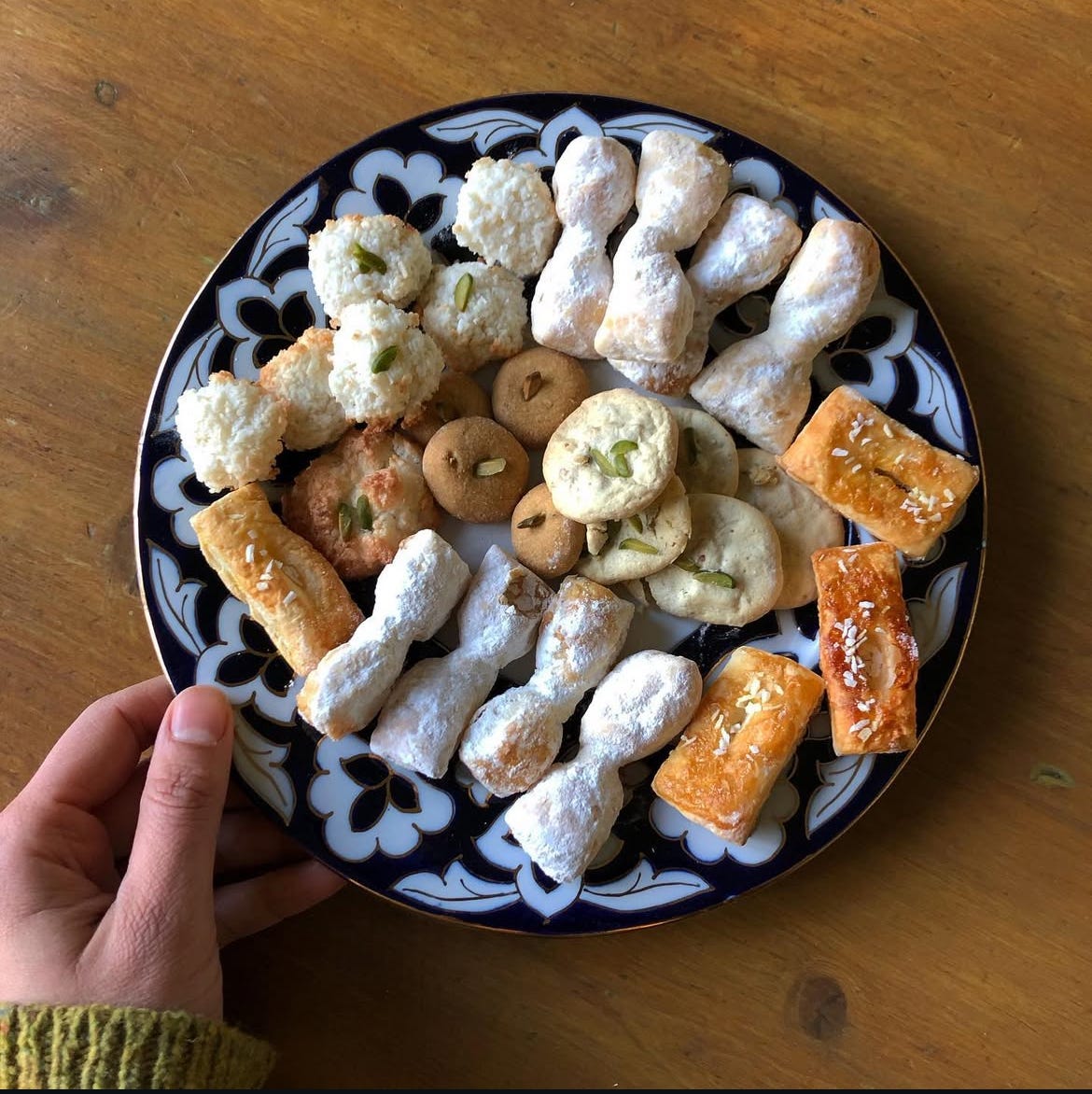
Our poems, literature, films, theatre, art, music, recipes and rituals carry the wisdom of generations. They shape identity. They hold memories. They transform everyday life into something enduring. And so this Nowruz, I am holding onto something small but stubborn. Not certainty. Not clarity. But the belief that even in the darkest moments, life insists on returning. That there will be another spring.
That one day, we will gather with our families and friends again — around a table, over a meal, in a country that is still ours, because it always will be — and mark the arrival of a new day.
Wishing a happy Eid and Happy Nowruz to all celebrating. And sending all my love to those carrying grief in these uncertain times xx
Thank you for sharing this heartfelt (and heartbreaking) post, Yasmin. I love Sabzi so much and have shared it here on my Substack. I truly believe that this (and your other books) spread awareness of your beautiful culture, and that the forms of creativity you mention (including food and recipes) are reminders of what connects us as humans. There is both so much more to say yet so few words to say it well. So, I'll just say once again, thank you for sharing, and for all that you do.
So sorry about the grief; I know how overwhelming it is. I've been feeling it for all my friends and people like you whose work I've followed. As someone who experienced war up close in Bosnia, I keep speaking and writing, trying to make people understand that war is "an abomination." Exactly what you said: there are no winners.
I know how hard it must have been to write this. And it is important to take breaks and breathe and celebrate. It's the only way to cope when faced with the enormity of world events that are beyond our control. Sending you a big hug.